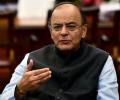
After the April-July fiscal deficit data was released on August 31, several analysts hinted that the government may need to go for cuts in capital expenditure to meet the fiscal deficit target.

As a percentage of the aggregate Budget expenditure, it is 12 per cent.

'The numbers are null and void now. Look, we can give out projections now, but we know that a week later those numbers will also be irrelevant. So we need to wait,' a top government official said.

The rupee sank below 60 rupees to the dollar and government bonds had their biggest single-day fall in a month on Monday as higher-than-expected May inflation compounded worries about the impact of violence in Iraq on the price of oil, which India imports.

The government's second round of stimulus will spur consumer spending in the near term but support to economic growth will be minimal, Moody's Investors Service said.
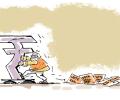
'Since the growth is not fast enough to provide jobs for the young, the fallout will be political and social,' warns T N Ninan.

Modi's government is also working on a universal health coverage plan that would provide all citizens with free drugs and diagnostic treatment.

Modi's unexpected announcement of achieving net zero by 2070 may have neatly deflected the pressures on India to sign up to an ambitious pledge but it does nothing to dispel the ecological emergency that threatens all life on the planet, , points out former forerign secretary Shyam Saran, the prime minister's special envoy and chief negotiator on climate change 2007-2010.

The Street was following the Karnataka election closely as a test for the Modi-led BJP's prospects in the 2019 Lok Sabha poll. Investors, however, are likely to wait for the next round of state elections to judge whether the momentum is still with it.

Over 15 years, with seven per cent growth, the Indian economy will be three times bigger.

The GDP always has a base year, which defines the composition of the economy in that year. As the composition changes, the base year needs to be revised regularly. Abhishek Waghmare explains how that is done.

India's sovereign debt is much lower than that of other emerging economies like Argentina, Indonesia, Mexico, the Philippines, and South Africa.

The government has spent a little less than one-third of the Budget estimate of capital expenditure, it can still spend about Rs 20,000 crore this year without disturbing its fiscal deficit target.

Chinese economy slowed down to 6.9 per cent last year.

Rupee ends at 61.89 against the dollar, falls for second straight day.

The 3 per cent target would now to reached a year later.

Curbing the federal deficit is the government's absolute priority on February 28.

The markets gained nearly 7 per cent in the 4 trading sessions of March.
One of the major contributors for the decline in growth will be the monsoon deficiency, which also affects non- agricultural sectors through demand effects, RBI report said.

The Organisation for Economic Cooperation and Development is a grouping of 34 countries.
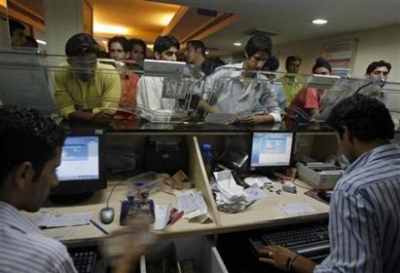
Private banks are assumed to be more efficient at intermediating between depositors and investors.

According to the global business information, knowledge and insight provider, India is likely to achieve an average growth rate of around 7.5 per cent during FY15-FY20.

Governor's statements will be weighed to gauge confidence level.
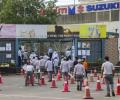
Top companies across sectors -- automobile maker Maruti Suzuki, consumer electronics giant Samsung to IT giant Infosys -- have reopened factories and offices as India took its first steps towards resuming economic activity after weeks under a near-total coronavirus lockdown.

If the Centre and states are keen on spending more to meet the COVID-19 challenges in the coming year, they must bear in mind the need to raise more resources through taxes and non-tax revenues, suggests A K Bhattacharya.

The government had projected the GDP growth to be at 8.5%.

It epitomises a significant opportunity lost, just when the state was beginning to shed three decades of leftist inhibitions in favour of economic reform.

The last sero-prevalence survey was held from August 1-7, which showed that 29.1 per cent of the people surveyed had antibodies against the coronavirus infection.v

It is not the job of regulators to ensure that users make profits. It is not the job of regulators to prevent people from making losses. It is not the job of regulators to prevent people from doing stupid things, argues Ajay Shah.
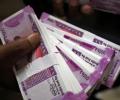
The major beneficiaries have been the ministries of roads and highways, railways and power

Finance Minister Nirmala Sitharaman on Monday said the government has come out with open and transparent Budget and has not made any attempt to hide anything under the carpet.

The report suggests India in the longer term needs to create far more jobs in the formal organised sector -- 97 per cent of all female worker activity is in the informal sector

Maharashtra's "radical" lockdown move will have an economic impact of Rs 40,000 crore, with the trade, hotels and transport sector to bear the biggest dent, Care Ratings said on Monday. The rating agency said the loss of economic activity will have a 0.32 per cent impact on the gross value added (GVA) growth at the national level. It revised down its national GDP growth estimate to 10.7 - 10.9 per cent from the 11 - 11.2 per cent given a week ago. Maharashtra has been contributing nearly 60 per cent to the daily COVID-19 infections nationally and had over 57,000 new cases on Sunday.

The manifesto also vowed to carry out caste-based census in 2020-21.
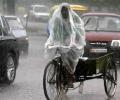
Next week could see some respite from the heat.
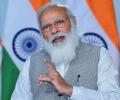
A faltering economy may have led to a re-think on economic strategy. And Mr Modi might think he is politically strong enough to take some risks. But there could be a minefield ahead, observes T N Ninan.

Even with the possible expenditure roll-overs and off-budget financing, the fiscal deficit target will not be met. The FRBM Act, after its amendment in 2018, allows a fiscal deficit slippage of not more than 0.5 per cent for any given year, provided there are justifications. These justifications include war, national security, severe collapse in the agriculture sector, a major natural calamity, big structural economic reforms, or the decline in real output growth of a quarter by at least 3 percentage points below its average of the previous four quarters.

Despite some sluggishness during 2009-10, the growth was largely on track during 2008-09 to 2012-13.

Sector-wise, the study revealed that the core industries have witnessed virtually negative growth in headcount, with crude oil just about maintaining the employment level.

Sikkim Chief Minister Pawan Kumar Chamling has promised to make every Sikkimese a 'crorepati' if he or she votes for his Sikkim Democratic Front in the April 12 Lok Sabha election, inviting criticism from his opponents.
